
Why Artists Need Other Artists
On friendship, criticism and the surprising gift of artistic fellowship.

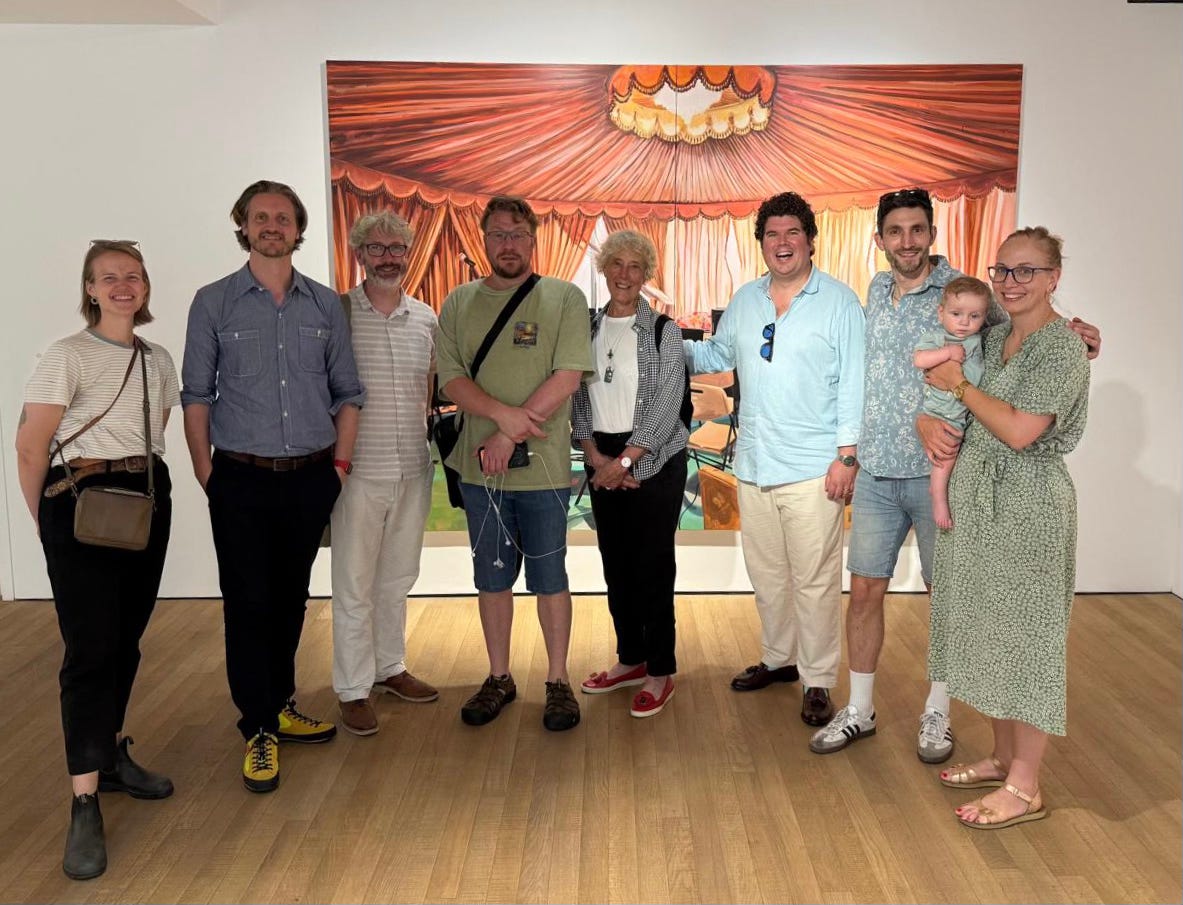
This week began with one of my favourite traditions.
Friends had gathered from both the United States and around the UK and, as we’ve done every few months for the past eight years, we spent the day on one of our regular gallery crawls across London.
There is now a familiar rhythm to these days. We begin with a major museum exhibition, continue over lunch, spend the afternoon exploring smaller commercial galleries, pause for coffee, squeeze in another exhibition or two and eventually end the day over dinner. You might say we take the hits for the team. I’ve long suspected that contemporary art in London is best served with generous quantities of caffeine and the occasional glass of cold beer.
Our group has evolved over the years. It includes artists, collectors, writers, art historians and, more recently, some of our children. We talk about paintings, politics, theology, culture and family life. We wrestle with questions of vocation and the curious business of trying to follow Christ while making contemporary art. We disagree, we challenge one another and, every so often, someone notices something in a painting that the rest of us had completely missed.
As I walked home that evening, it struck me that these conversations have become one of the great gifts of my artistic life. They also reminded me of something I’ve come to believe over many years.
Artists need other artists.
That may sound obvious, but it cuts against one of the great myths of Western art. We love the image of the solitary genius: the painter alone in the studio, the novelist shut away in an attic, the sculptor wrestling single-handedly with marble. Solitude certainly has its place. Most artists spend long hours working alone. We disappear into our studios, walk the hills with sketchbooks, wander galleries by ourselves and stare for hours at paintings that simply refuse to cooperate.
Making art often requires solitude yet flourishing as an artist rarely does. Sometimes you simply need another pair of eyes on a painting. Sometimes you need someone to ask the awkward question you’ve been avoiding. Sometimes you need practical advice about exhibitions, galleries or commissions. Sometimes you simply need a friend to remind you why you started making art in the first place.
History bears this out. The great works of art have often emerged not from isolation but from friendship. Think of C. S. Lewis and J. R. R. Tolkien. Along with the other members of the Inklings, they met regularly to read unfinished work aloud, challenge one another’s ideas and offer encouragement, and often with beer in hand. It is difficult to imagine The Lord of the Rings or the Chronicles of Narnia taking quite the same shape without those evenings spent together in conversation.
The same is true of painters. The Impressionists are remembered today as remarkable individuals, but they learned together, exhibited together and continually sharpened one another’s vision. The story repeats itself throughout art history, from the Pre-Raphaelites to the artists of St Ives, from the Bloomsbury Group to countless smaller communities that history barely remembers.
Even Vincent van Gogh, perhaps the very symbol of the lonely artist, dreamed not of isolation but of companionship. When he moved to Arles, he hoped to establish what he called the “Studio of the South”, a community where artists would live, paint and inspire one another. For a brief period Paul Gauguin joined him there. We know, of course, how the story ended. The experiment collapsed spectacularly, culminating in one of the most infamous arguments in the history of art.
It is tempting to remember only the failure yet I’ve always found it deeply moving that Van Gogh’s great ambition was not simply to become a better painter, but to create a fellowship of artists. Even the archetypal solitary genius longed for community. Perhaps that is because creativity itself is deeply relational.
The gallery crawl was only the beginning of the week.
A few days later I spent time with our resident artists in East London, leading a drawing workshop outdoors. We spent the afternoon drawing en plein air, comparing sketches, sharing discoveries and learning from one another.
Again, what struck me wasn’t simply the value of drawing. It was the value of drawing together. One of the unexpected privileges of helping lead an artist residency is watching this happen time and again. Artists often arrive expecting to learn primarily from mentors or visiting tutors. Instead, many discover that they learn just as much from one another. The studio next door, the conversation over lunch, the gentle critique at the end of the day, these are often where the deepest formation takes place.
Later in the week I visited my friend Sally’s MA exhibition at Camberwell.
Sally and I have spoken most weeks since the first covid lockdown. Our conversations wander between art, psychology, theology, books, exhibitions and whatever either of us happens to be wrestling with that week. Sometimes we’re discussing a painting that isn’t quite working. Sometimes we’re talking about life. More often than not, the two turn out to be the same conversation.
Those conversations have become one of the most important parts of my artistic practice. Not because we always agree, but because good friends make better artists.
There is an old proverb that says,
“If you want to go fast, go alone. If you want to go far, go together.”
Whether or not those are the exact words, I can’t quite remember, but the sentiment feels deeply biblical.
Scripture is remarkably suspicious of isolation. Jesus sends his disciples out in pairs. The early Church devoted itself not simply to teaching but to fellowship. Paul’s letters are filled with the names of friends, collaborators and fellow workers. Even the image of the Church itself is communal - a body rather than a collection of disconnected individuals.
But this shouldn’t surprise us. The first thing in creation that God declares “not good” is not sin. It is solitude. It was not good for the man to be alone.
We are made in the image of a God who exists eternally in relationship - Father, Son and Holy Spirit. If relationship lies at the very heart of reality, perhaps it should not surprise us that creativity flourishes there too.
Of course, there are paintings only you can paint and poems only you can write. No one else can do that work for you. But neither should we attempt the journey alone.
The older I become, the less convinced I am that the greatest gift in an artist’s life is inspiration. I suspect it is companionship.
The friends who ask awkward questions.
The ones who are bold enough to tell you that the painting isn’t quite finished.
The ones who celebrate when it finally is.
The ones who have walked beside you for eight years, one gallery crawl, one coffee and one conversation at a time.
Looking back over this week, I realised again what a remarkable gift those friendships have been. I begin to suspect some of the best work I’ve ever made owes as much to those conversations as it does to anything I’ve ever done alone.
Thanks for reading this article. I write for free and with joy. You can increase the joy by becoming a paid subscriber or you can simple buy me a coffee to say ‘liked it’.
This sounds just about right: ”The older I become, the less convinced I am that the greatest gift in an artist’s life is inspiration. I suspect it is companionship.”
When I was painting, and now in book-repairing, and in trying to write history, while the work is often necessarily alone and heavy, yet a few people who share your sense of purpose and desire are such an encouragement. I look back with thanks to moments like that - to people who were there and who were sympathetically engaged. You said all that nicely and succinctly!